PartnershipSan Francisco, Albuquerque, N.M., and Little Rock, Ark.
Rayca Precision, the University of New Mexico and UAMS Partner to Develop a First-in-Class Therapeutic for HPV-Driven Cancers
Three-party co-development program pairs AI-driven molecular design with cancer biology and medicinal chemistry to address a significant unmet medical need
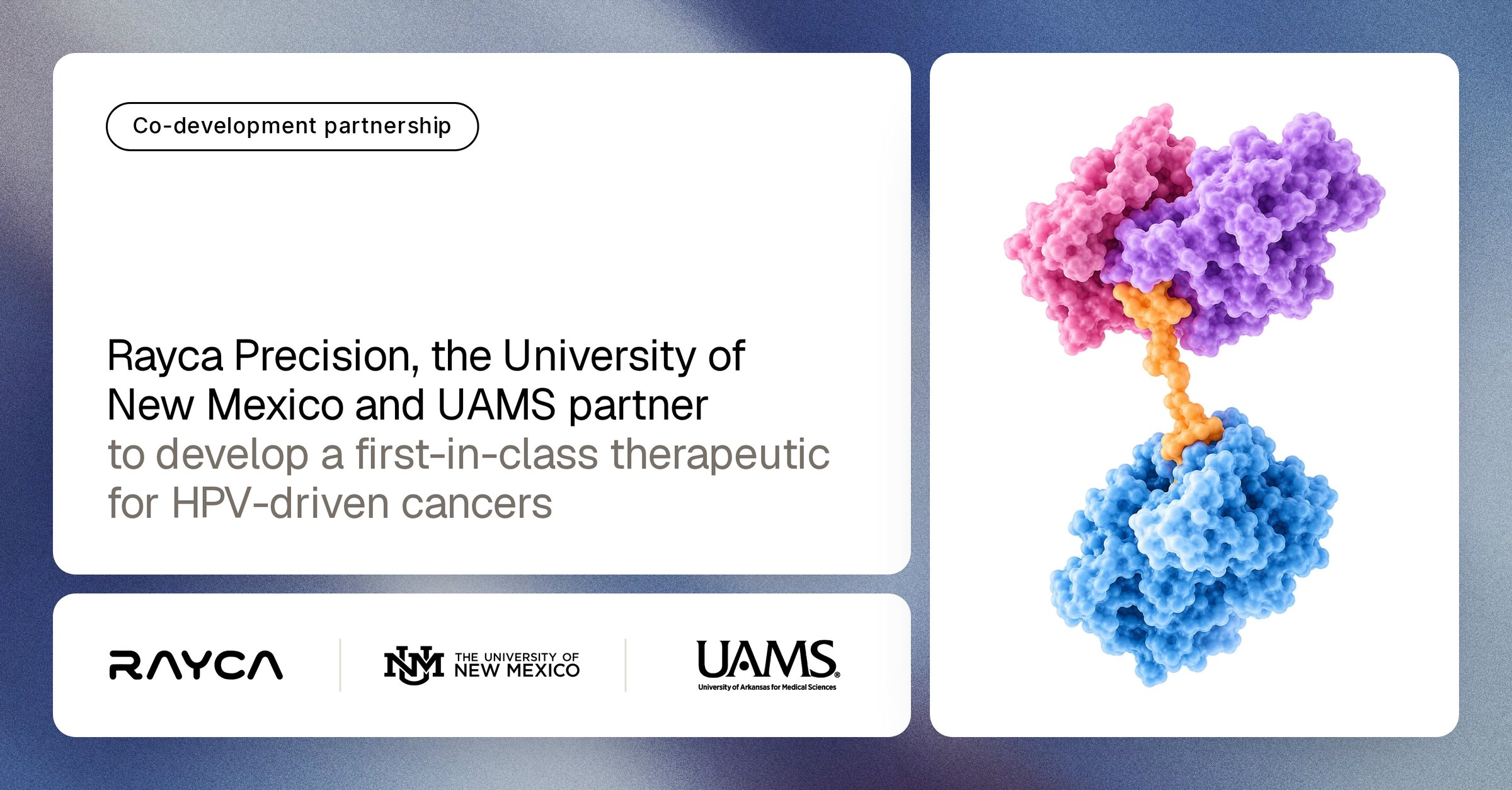
Rayca Precision, the University of New Mexico (UNM) and the University of Arkansas for Medical Sciences (UAMS) today announced a three-party co-development agreement to discover novel therapies for cancers associated with high-risk human papillomavirus (HPV).
The collaboration brings together complementary expertise in artificial intelligence-enabled drug discovery, HPV biology, translational oncology, medicinal chemistry, and pharmaceutical research. The partners will work to identify and evaluate potential therapeutic candidates for HPV-associated cancers and precancerous disease, with the goal of generating a strong foundation for future preclinical development and strategic partnering.
Rayca Precision will lead computational discovery and program coordination. The UNM Comprehensive Cancer Center will contribute expertise in HPV biology and translational disease models. UAMS will contribute medicinal chemistry, synthesis, and compound-development expertise. The partners will jointly review program progress and determine future development priorities based on emerging research data.
HPV causes close to five percent of cancers worldwide.¹ Cervical cancer alone accounted for an estimated 662,000 new cases and 349,000 deaths in 2022, and on current rates cases are projected to rise 57 percent and deaths 81 percent by 2050.² In the United States, oropharyngeal cancer has become the most frequently diagnosed HPV-associated cancer, with incidence rising in men for two decades.³ Vaccination prevents new infections. It does not treat the people already infected, and the cancers reaching clinics today come from infections acquired years earlier.
Care for established HPV-positive disease remains surgery, radiation, chemotherapy and, in advanced settings, immunotherapy. None of it addresses the viral driver of the tumor. The collaboration is pursuing two settings, established HPV-positive cancer, including cervical and head and neck disease, and high-grade precancerous lesions, where surgery is currently the only option and the patient population is far larger.
“This is a target the field has wanted for thirty years and has not been able to reach. Our engine was built for problems where the conventional route has already failed, and this partnership puts it in front of two laboratories that can tell us quickly whether the designs hold up.”
“We have spent years building models that show how HPV behaves in human tissue rather than in a dish. What we have not had is chemistry matched to that biology. This collaboration brings it.”
UAMS researchers note that the value of computational design is reflected in the ability to focus laboratory resources on the most promising compounds. By working from a prioritized set of candidates, an academic laboratory can move through the design, make and test cycle more efficiently, helping accelerate the pace of research.
For prospective partners and investors, the opportunity carries characteristics that are uncommon in early oncology. The patient population is molecularly defined and already identified in routine clinical care through HPV diagnostics. The biology is specific to virally driven tumors. And no competing program is pursuing the same approach, which leaves first-in-class composition-of-matter space open. The parties intend to file jointly as candidates emerge and to engage pharmaceutical partners for clinical development.
Forward-looking statements: The program is in the research and early drug-discovery stage. It is not a clinical trial, and no product arising from the collaboration has been approved by the U.S. Food and Drug Administration or any other regulatory authority. There can be no assurance that the program will produce a development candidate or that any future candidate will demonstrate safety or efficacy in humans.
References
- de Martel C, Plummer M, Vignat J, Franceschi S. Worldwide burden of cancer attributable to HPV by site, country and HPV type. Int J Cancer. 2017;141(4):664–670. doi.org/10.1002/ijc.30716 (opens in a new tab)
- Wu J, Jin Q, Zhang Y, et al. Global burden of cervical cancer: current estimates, temporal trend and future projections based on the GLOBOCAN 2022. J Natl Cancer Cent. 2025;5(3):322–329. doi.org/10.1016/j.jncc.2024.11.006 (opens in a new tab)
- Van Dyne EA, Henley SJ, Saraiya M, Thomas CC, Markowitz LE, Benard VB. Trends in human papillomavirus–associated cancers — United States, 1999–2015. MMWR Morb Mortal Wkly Rep. 2018;67(33):918–924. doi.org/10.15585/mmwr.mm6733a2 (opens in a new tab)
About Rayca Precision
Rayca Precision is the collective intelligence layer and operating engine for AI-powered therapeutic discovery. The company works across small molecules, peptides, macrocycles and biologics, and directs its platform at targets that have resisted conventional discovery approaches. Rayca advances its pipeline through co-development partnerships with pharmaceutical companies, discovery organizations and leading academic laboratories, with programs in oncology, immuno-oncology and rare disease.
About the UNM Comprehensive Cancer Center
The University of New Mexico Comprehensive Cancer Center is the official cancer center of New Mexico and the only cancer center in the state designated by the National Cancer Institute. The Ozbun Laboratory, in the UNM School of Medicine, is internationally recognized for its work on papillomavirus biology and disease models.
About the University of Arkansas for Medical Sciences
The University of Arkansas for Medical Sciences is the state’s only health sciences university. Its Winthrop P. Rockefeller Cancer Institute is the only academic cancer center in Arkansas and offers more cancer clinical trials across more cancer types than any other institution in the state. The Jones Laboratory, in the Department of Pharmaceutical Sciences at the UAMS College of Pharmacy, works in medicinal chemistry and chemical biology.
Media Contacts
- Rayca Precision
- Pouya Behrouzi, Co-Founder and Chief Executive Officer | pouya@raycabio.com
- University of New Mexico Health Sciences
- Michele W. Sequeira, Community Relations | Editorial Manager, UNM Comprehensive Cancer Center | 505-548-0927 | MSequeira@salud.unm.edu
- University of Arkansas for Medical Sciences
- Andrea Peel, Associate Vice Chancellor, UAMS Communications & Marketing | 501-686-8996 | PeelAndreaL@uams.edu