Rayca Precision Molecular intelligence that reasons, computes and learns
Rayca learns why therapeutic candidates succeed or fail, then uses that knowledge to guide design, simulation and experiment across modalities.
The attrition problem 01
Rayca preserves supported failure patterns as design principles for future candidates.
Failure analysis and design constraints
Representative oncology programMolecular design question
What did every prior molecule prove this design must avoid?
Assays
Assay systems and LIMS
18,240 molecular outcomes
Chemistry
Registries and notebooks
3,120 synthesized compounds
Structures
Experimental and modelled
46 conformational records
Developability
ADME and safety reports
212 liability reports
Decisions
Reviews and meeting notes
390 program reviews
Scientific expertise
Distributed across teams
14 domain specialists
15 years
Typical target-to-approval timeline
$2.6B
Cost per approved drug
90%
Of clinical candidates lost
Commonly cited industry estimates. Each cell is one clinical candidate.
The intelligence layer 02
Across successive programs, that understanding can grow toward molecular superintelligence.
Across successive programs, that understanding can grow toward molecular superintelligence.
The architecture of operating molecular intelligence
Evidence, models and physics- Sovereign by design. Your science and intelligence stay yours.
- Auditable decision lineage. Evidence, methods and uncertainty remain exposed.
- Calibrated on each DMTA cycle. New assay results extend the program-specific evidence base.
Layer 01 · Persistent program knowledge
4,612 outcomes
What the therapeutic program has learned, held in a usable form.
- Assays
- Chemistry
- Structures
- ADME
- Safety
- Notes
Lineage of one value
- RC-0512, PARP2 IC50
- Partner laboratory export
- Units and assay version reconciled
- Linked to structure, series and notes
Context preserved
Results remain connected to candidate, experiment and source.
Failure retained
Observed liabilities remain linked to the designs that produced them.
Learning carried forward
Future candidates inherit supported design principles.
Advances an expanding model of molecular possibility
Our approach 03
Project teams review an integrated candidate profile before committing the next experiment.
Integrated candidate assessment
RC-0512- Medicinal chemistrySAR, synthetic tractability
- Structural biologyBinding mode, pocket states
- BiochemistryPARP1 and PARP2 potency
- DMPKSolubility, permeability, clearance
- SafetyhERG, blood counts
- TranslationalExposure at projected dose
3 vectors open
H-bond to Gly863
PARP1 1.2 nM
85 µM soluble
hERG > 30 µM
50 mg once daily
Molecular perception 01
Connect the program’s molecular evidence.
Evidence entering the molecular world model
- Compound registry3,120 compounds
- PARP1 and PARP2 assays9,804 values
- Crystal structures12 files
- ADME panel418 results
- Rat safety study1 report
- Meeting notes64 documents
Principle formation 02
Learn from why earlier candidates failed.
| PARP1 IC50 | PARP2 IC50 | Kinetic solubility | Caco-2 efflux | hERG | Rat blood counts | |
|---|---|---|---|---|---|---|
| RC-0412 | ||||||
| RC-0433 | ||||||
| RC-0451 | ||||||
| RC-0467 | ||||||
| RC-0480 | ||||||
| RC-0486 | ||||||
| RC-0490 | ||||||
| RC-0494 | ||||||
| RC-0497 | ||||||
| RC-0503 |
Each cell is one measured outcome. Red cells failed their target product profile threshold.
Failure mode
PARP2 activity
Tracks with the platelet and neutrophil drop in the 14-day rat study.
Design principle, now executable
PARP2 / PARP1 IC50 ratio of 100 or more
Seen in 5 compounds, backed by 22 measurements
Intelligence-guided design 03
Generate new candidates within the program’s design principles.
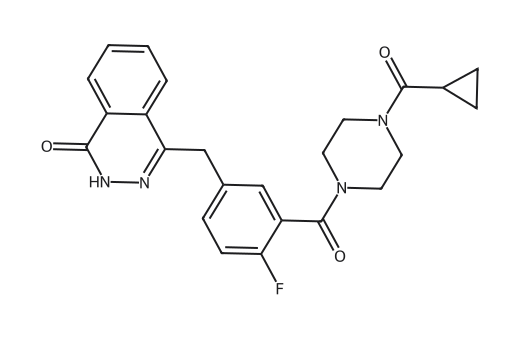
Olaparib, the reference chemotype
0 proposed, 0 pass every rule
Each cell is one generated molecule. Ink passed every constraint, red broke a learned constraint, grey scored below the potency model.
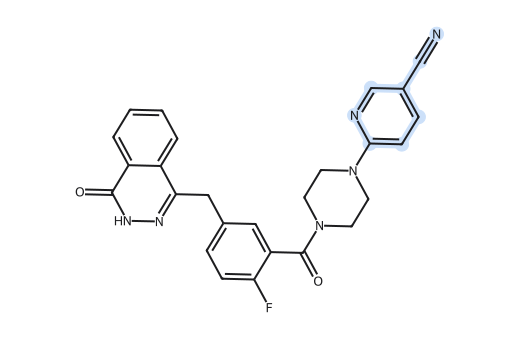
RC-0512
Cyanopyridine replaces the amide cap
- PARP2 window–
- cLogP below 3–
- No basic amine–
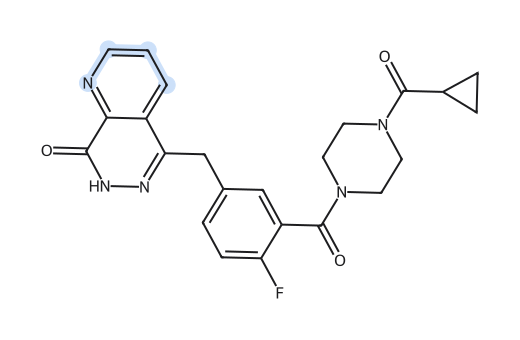
RC-0515
A nitrogen added to the core ring
- PARP2 window–
- cLogP below 3–
- No basic amine–
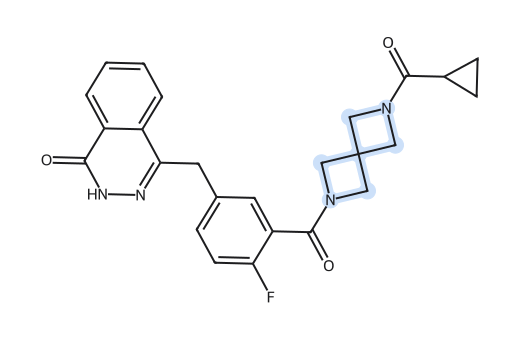
RC-0518
A spiro ring replaces the piperazine
- PARP2 window–
- cLogP below 3–
- No basic amine–
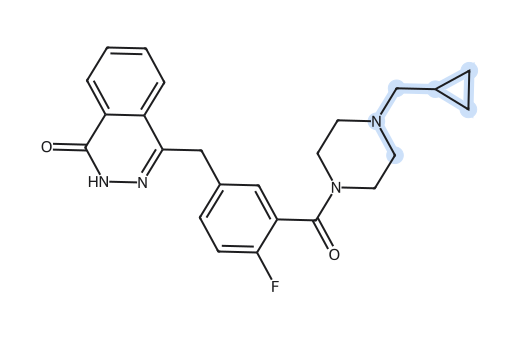
RC-0521
A basic amine on the piperazine
- PARP2 window–
- cLogP below 3–
- No basic amine–
Physical reasoning 04
Test promising candidates with physical simulation.
- Ensemble docking9 compounds · CPU
- Molecular dynamics, 100 ns6 compounds · GPU
- RBFE, PARP13 compounds · GPU
- RBFE, PARP23 compounds · GPU
GPU fleet. Blue cells run this campaign.
Predicted PARP2 / PARP1 window
- RC-0512–
- RC-0518–
- RC-0515–
Line marks the 100-fold constraint.
Molecular action 05
Return a prioritized design and experiment plan.
Cycle 5 synthesis plan
- 01SynthesiseRC-0512 and RC-0518Pass every rule and are predicted to favour PARP1 by 140 to 180 times.
- 02Run firstPARP2 counter-screen and 7-day rat CBCConfirms the window in vitro and in vivo before scale-up.
- 03DeprioritiseRC-0515 and RC-0521RC-0515 misses the selectivity threshold; RC-0521 violates the efflux constraint.
Intelligence behind this action
4,612
records
3
constraints
9
simulations
1
partner assay
RC-0512 against the target product profile
- PARP1 IC50, predicted–
- PARP2 / PARP1 window–
- cLogP–
- Basic amine–
- Caco-2 efflux ratio, predicted–
Molecular intelligence, by cycle
C1
C2
C3
C4
C5
Lab results return to the program record and cycle 5 starts from there.
Representative program. Values are illustrative.
Lab in the loop 05
The next design cycle incorporates the new assay result and its provenance.
Where intelligence meets experiment
PARP2 cellular counter-screen1/5 Open question
- Question
- Does the PARP2 window hold in cells?
- Matched assay
- Cellular PARP2 counter-screen, partner catalogue
- Approval
- Approved by the project lead
- PARP2 IC50, RC-0512
- > 3 µM
- Molecular world model
- Selectivity principle updated for cycle 5
Darker wells show stronger PARP2 inhibition. Red marks a compound losing its window. Illustrative.
Where we differ 06
Experimental capacity is focused on candidates supported by the program’s evidence.
Experimental capacity is focused on candidates supported by the program’s evidence.
Failure patterns guide future designs
Supported reasons for failure remain available as principles for future candidates.
- PARP2 window
- cLogP below 3
- No basic amine
The scientific question shapes the work
Rayca selects and supervises the models and simulations needed for the program decision.
RBFE campaign · 0 of 48 GPUs allocated
Recommendations retain scientific lineage
Recommendations trace to the molecules, evidence, methods and uncertainty that produced them.
Scientists remain in command
Rayca expands the team’s capacity to reason and execute. Scientists retain every go and no-go decision.
Partnering 07
The engagement tests Rayca against proprietary evidence and real program decisions.
The engagement tests Rayca against proprietary evidence and real program decisions.
Program intelligence engagement
Defined therapeutic programDefine the decision
A defined program and consequential question
Establish the world model
Evidence connected inside your environment
Run the intelligence loop
Principles, design, physics and compute
Return molecular action
Prioritized designs and experiments
Program intelligence
The hidden constraints, unresolved questions and next actions inside a running program.
Molecular second opinion
Independent reasoning before the next synthesis or IND-enabling commitment.
Failure-to-principle analysis
Past attrition converted into constraints the next design must respect.
Intelligence-guided design cycle
New matter designed, physically tested and prioritized with complete lineage.
What the intelligence loop returns
Molecular world model
Program evidence connected with provenance.
Executable design principles
Failure modes converted into future constraints.
Prioritized molecular actions
What to design, simulate and test next.
Reasoning for each recommendation
Evidence, methods and uncertainty exposed.
Advancing molecular intelligence with institutions at the scientific frontier.
Our collaborators connect molecular intelligence to frontier biology, translational science and therapeutic creation. Rayca is part of the DayOne Accelerator in Basel and Health Incubator Helsinki.
Therapeutic co-development partners






Accelerator and ecosystem partners





Vision 08
The destination is an intelligence capable of understanding and engineering molecular systems beyond the reach of any individual model, discipline or program.
The destination is an intelligence capable of understanding and engineering molecular systems beyond the reach of any individual model, discipline or program.
The path to molecular superintelligence
Our direction- L1ConnectedCompounds, assays and decisions share traceable molecular context.Today
- L2Principle-formingObserved outcomes define evidence-linked molecular constraints.Today
- L3OperationalThe system reasons, designs and runs computation.Today
- L4ExperimentalIt proposes and coordinates experiments with scientific approval, then learns from reality.In development
- L5Molecular superintelligenceIt connects biological hypotheses with development-candidate design across disciplines and modalities.Our direction